Why is heat treatment used for steel products? The answer begins with performance, not appearance. Steel may leave a mill strong enough for shaping, yet unsuitable for demanding service. Controlled heating and cooling can change its internal structure. This improves hardness, toughness, strength, wear resistance, or dimensional stability.
In practice, an experienced metallurgist selects a cycle for the steel grade and final application. The furnace temperature must remain stable across the load. A small gear may require different treatment from a thick axle. After heating, operators may quench the parts in oil, water, polymer, or air. Each method produces different cooling behavior. Tempering can then reduce brittleness and relieve harmful internal stresses. Inspectors check hardness, surface condition, distortion, and sometimes the microstructure under a microscope.
The details matter greatly. Poor temperature control can leave soft areas inside a hardened component. Excessive quenching may create cracks or unwanted distortion. Qualified engineers therefore use calibrated equipment, traceable records, and relevant ASTM, ISO, or customer specifications. Tests should confirm that the process achieved its intended properties, rather than relying on appearance alone.
Heat treatment is not a magic reset. Steel history still matters. Its chemistry, previous forming, section thickness, and surface condition influence the result. Even a carefully designed cycle can need adjustment after production evidence appears. This honest review is essential for reliable manufacturing. When applied with knowledge and verification, heat treatment helps steel products survive pressure, friction, impact, and repeated loading with greater confidence.
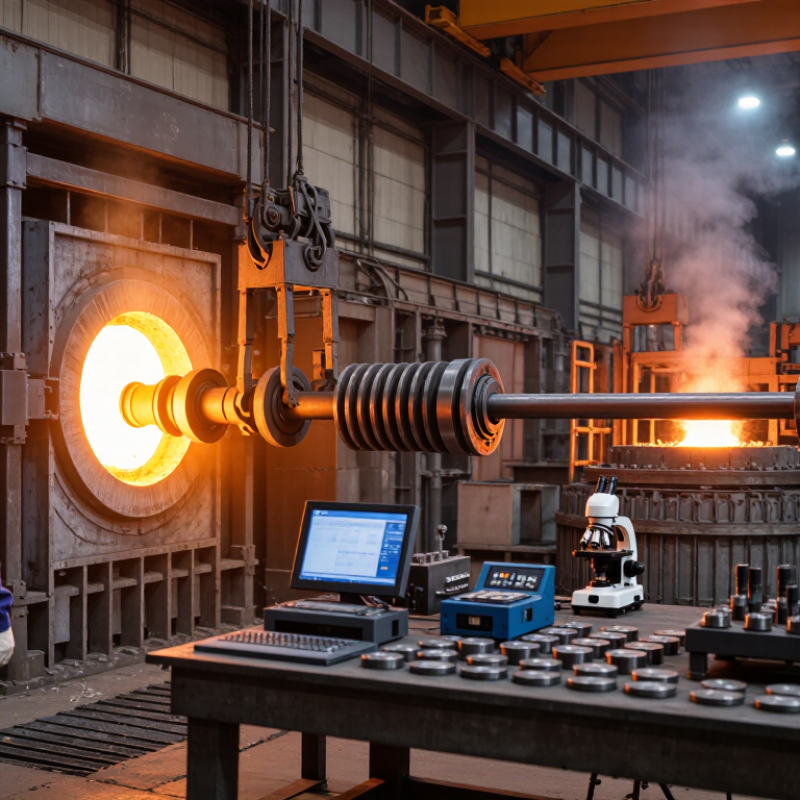
What Is Heat Treatment in Steel Manufacturing?
Heat treatment in steel manufacturing is a controlled cycle of heating, holding, and cooling. It changes the steel’s internal structure without changing its chemical composition. Operators select the cycle according to carbon content, alloying elements, part thickness, and required performance. A furnace may heat a gear slowly, hold it at a specified temperature, then cool it in air, oil, water, or a controlled atmosphere. Each choice affects hardness, toughness, ductility, and dimensional stability. The process sounds simple. It is not.
Common treatments include annealing, normalizing, quenching, and tempering. Annealing softens steel and improves machinability. Normalizing refines grain structure after forging or casting. Quenching creates a hard martensitic structure, but it can also introduce stress and cracking. Tempering follows quenching to reduce brittleness and balance strength with toughness. In a workshop, technicians check furnace calibration, load spacing, soak time, and cooling conditions. Thermocouples and hardness tests provide evidence that the cycle worked. A color change alone is not reliable evidence.
Heat treatment is used because steel parts rarely need maximum hardness everywhere. A shaft may need a tough core and a wear-resistant surface. Case hardening can support that combination, while induction heating can treat selected areas. Results depend on steel chemistry and prior processing, so copied schedules can fail. Even a well-designed cycle may produce distortion. Engineers should compare hardness maps, dimensions, and fracture observations before approving production. Some decisions remain judgment-based, which deserves careful review.
How Does Heat Treatment Change Steel Properties?
2026 Top Why Is Heat Treatment Used for Steel Products?
Heat treatment changes steel by controlling temperature, holding time, and cooling speed. These steps rearrange its internal structure, called microstructure. A fast quench can form martensite, producing high hardness and strength. However, untreated martensite is often too brittle for shafts, gears, or bolts. Tempering reduces internal stress and improves toughness, although some hardness is sacrificed.
Normalizing refines coarse grains and creates more consistent mechanical behavior. Annealing softens steel, making drilling, bending, and machining easier. Case hardening creates a hard surface while keeping the core relatively tough. This combination suits parts exposed to wear and repeated impact. According to the ASM Handbook, Vol. 4, Heat Treating, final properties depend strongly on carbon content, alloy chemistry, section thickness, and cooling conditions. A small change in quench severity can produce a large hardness difference.
The scale is substantial. World Steel Association’s World Steel in Figures 2024 reports approximately 1.89 billion tonnes of crude steel production in 2023. Even a minor treatment error can affect many components. In practical workshops, furnace uniformity, loading patterns, and transfer time deserve close attention. A specification may promise 50 HRC, but actual readings can vary across one part. That variation is easy to underestimate. Residual stress, distortion, and decarburization still require inspection through hardness testing, dimensional checks, and metallographic examination. Heat treatment works powerfully, but it is not perfectly predictable.
2026 Top Why Is Heat Treatment Used for Steel Products? - How Does Heat Treatment Change Steel Properties?
| Heat Treatment Process |
Typical Heating Range* |
Cooling Method |
Main Microstructural Change |
Effect on Steel Properties |
Common Purpose |
| Annealing |
Approximately 650–950°C, depending on grade |
Slow cooling, usually inside the furnace |
Forms relatively soft ferrite–pearlite structures and reduces internal stresses |
Lower hardness and strength; improved ductility and machinability |
Softening steel, improving workability, and relieving manufacturing stresses |
| Normalizing |
Typically 30–80°C above the upper critical temperature |
Cooling in still air |
Produces a finer and more uniform ferrite–pearlite structure than many slow-cooled conditions |
Usually higher strength and hardness than annealed steel, with useful toughness |
Refining grain structure and improving uniformity after forging, casting, or rolling |
| Quenching |
Usually above the austenitizing temperature; often about 760–950°C for carbon steels |
Rapid cooling in water, oil, polymer solution, or gas |
Transforms austenite into martensite when cooling is sufficiently rapid |
Strong increase in hardness and strength, with reduced ductility and increased distortion risk |
Developing high hardness and wear resistance before tempering |
| Tempering |
Approximately 150–650°C after quenching |
Controlled cooling, commonly in air |
Relieves stresses in martensite and forms tempered martensite |
Reduces brittleness and hardness while improving toughness and dimensional stability |
Balancing hardness, strength, toughness, and service reliability |
| Stress Relieving |
Often about 500–650°C for carbon and low-alloy steels |
Slow, controlled cooling |
Reduces residual stresses with limited change to the original phase structure |
Improves dimensional stability and lowers the risk of cracking or distortion |
Stabilizing welded, machined, cast, or cold-worked components |
| Case Hardening |
Commonly about 850–950°C for carburizing; process-dependent |
Usually quenching followed by tempering |
Adds carbon to the surface, creating a hard case over a tougher low-carbon core |
High surface hardness and wear resistance with improved core toughness |
Protecting gear teeth, shafts, pins, and other components exposed to contact wear |
| Induction Hardening |
Surface heated rapidly above the austenitizing range; exact temperature depends on grade |
Rapid spray or immersion quenching |
Creates a martensitic surface layer while the core remains comparatively tough |
High surface hardness, improved fatigue resistance, and limited bulk distortion |
Selective hardening of areas such as bearing seats, teeth, and wear surfaces |
| Solution Treatment and Aging |
Common for precipitation-hardening stainless steels; often about 950–1,100°C for solution treatment |
Rapid cooling, followed by controlled aging |
Dissolves alloying elements, then forms fine strengthening precipitates during aging |
Increases yield strength and hardness while maintaining useful corrosion resistance |
Strengthening selected stainless and nickel-containing precipitation-hardening alloys |
*Temperature ranges are general engineering references. Actual heat-treatment temperatures, holding times, cooling rates, case depths, and property targets must be selected according to the steel grade, section thickness, geometry, and applicable specification.
Which Heat Treatment Processes Are Used for Steel Products?
Steel products need heat treatment because controlled heating and cooling change their internal structure. The process can improve hardness, toughness, machinability, wear resistance, or dimensional stability. In 2024, global crude steel production reached about 1,882.6 million tonnes, according to World Steel Association data. Even small treatment errors can therefore affect enormous production volumes.
Which heat treatment processes are used for steel products? Annealing softens steel and improves machinability after forming or welding. Normalizing refines the grain structure and produces more uniform mechanical properties. Quenching cools heated steel rapidly, usually in water, oil, or polymer solutions, to create high hardness. It can also introduce distortion. Tempering follows quenching and reduces brittleness while restoring useful toughness. Many workshops use both steps together. Case hardening, including carburizing and nitriding, creates a hard surface with a tougher core for gears, shafts, and pins. Austempering can provide a useful balance between strength and ductility. Stress relieving is gentler, but it matters after machining or welding.
Energy use deserves closer attention. The International Energy Agency estimates that iron and steel production causes roughly 7% of global energy-related carbon dioxide emissions. Better furnace insulation, accurate temperature measurement, and shorter holding times can reduce waste. Still, a digital control system cannot replace sound metallurgical judgment. A recipe may look correct, yet a thick section can cool unevenly. That detail is easy to overlook. Standards such as ASTM A941 and ISO 4885 help define metallurgical terms, but production results still require testing, traceability, and careful review.
Why Is Heat Treatment Important for Steel Performance?
Heat treatment is important because it changes steel’s internal structure, not merely its surface appearance. Heating and controlled cooling can increase hardness, toughness, strength, wear resistance, and fatigue life. These properties determine whether a gear survives repeated loads or a shaft bends under pressure.
The process must match the steel grade and product design. Quenching may produce high hardness, but it can also create internal stress, distortion, or cracking. Tempering reduces these risks and improves toughness. Annealing can soften steel, making machining easier and reducing residual stress. A practical example is a medium-carbon steel shaft: after quenching and tempering, it may resist wear while still absorbing impact during operation.
Heat treatment requires careful control. Furnace temperature, holding time, cooling speed, and part thickness all influence the final result. Technicians often verify performance through hardness testing, dimensional checks, and metallographic examination. Records also help trace unusual failures.
Harder is not always better.
A common mistake is choosing maximum hardness without considering service conditions. A brittle component can fail suddenly, even when its hardness report looks excellent. No heat-treatment cycle is perfect for every product. Engineers may need to adjust the process after reviewing distortion, surface scale, or unexpected test results. That reflection matters because reliable steel performance depends on balanced properties, not one impressive number.
Why Is Heat Treatment Used for Steel Products?
Representative room-temperature mechanical properties of medium-carbon steel in different heat-treated conditions
Heat treatment changes the steel microstructure to balance strength, hardness, ductility, toughness, and machinability.
Quenching and tempering generally provide much higher strength than annealing, while annealing improves workability.
The values shown are representative engineering values for AISI 1045 steel; actual results vary with section size, cooling rate, and processing parameters.
How Is the Right Heat Treatment Method Selected?
Choosing the right heat treatment for steel starts with the part’s working conditions, not a standard recipe. Engineers examine load, friction, impact, temperature, and corrosion exposure. The target is not simply hardness. Toughness, dimensional stability, and fatigue resistance may matter more. Steel grade matters. Carbon content, alloying elements, and prior processing change the final response.
A shaft exposed to repeated bending may need a tough core and a harder surface. Case hardening can support this combination. A thick gear may require controlled heating, slow soaking, and carefully selected quenching. Through-hardening can work for smaller sections with consistent geometry. Induction treatment suits selected surface areas and can limit heat distortion. Tempering is normally adjusted after hardening because excessive hardness can create brittle behavior. That trade-off is easy to underestimate.
Real selection also depends on equipment, section thickness, and production volume. Technicians should review published material data, applicable standards, and previous shop results. Hardness testing alone is not enough. Cross-sectional hardness checks, dimensional inspection, and microscopic examination provide stronger evidence. Small test coupons can reveal problems before full production begins. They are worth the time.
The process is rarely perfect on the first attempt. A slight corner crack, unexpected distortion, or uneven hardness may expose an incorrect assumption. Engineers should record furnace temperature, transfer time, quench conditions, and tempering results. Then they can adjust one variable at a time. Heat treatment is controlled metallurgy, but it still requires judgment.
FAQS
It controls heating, holding time, and cooling speed. These steps rearrange the steel’s microstructure. Hardness, strength, toughness, and machinability can change.
Quenching cools heated steel quickly. It can create martensite, which provides high hardness and strength. Fast cooling may also cause distortion.
Untempered martensite can be too brittle for shafts, gears, and bolts. Tempering reduces internal stress and improves toughness. Some hardness is sacrificed.
Annealing softens steel and improves machinability. Drilling, bending, and cutting become easier. It can help after forming or welding.
Normalizing refines coarse grains and improves consistency. It can produce more uniform mechanical behavior across a component. Results still depend on cooling conditions.
Case hardening creates a hard outer surface and a tougher core. This suits gears, pins, and shafts facing wear and repeated impacts.
Carbon content, alloy chemistry, section thickness, and cooling speed all matter. Furnace uniformity matters too. A thick section may cool unevenly.
Yes. Possible problems include distortion, residual stress, decarburization, and uneven hardness. A specification may state 50 HRC, yet readings can vary.
Use hardness testing, dimensional checks, and metallographic examination. Check several areas, not one convenient spot. I might underestimate variation without careful records.
Better insulation, accurate temperature measurement, and shorter holding times can reduce waste. Digital controls help, but they cannot replace metallurgical judgment. Controls are not magic.
Conclusion
Heat treatment is a controlled heating and cooling process used to modify the internal structure of steel. By adjusting temperature, holding time, and cooling speed, manufacturers can change important properties such as hardness, strength, toughness, ductility, wear resistance, and dimensional stability. Common methods include annealing, normalizing, hardening, tempering, carburizing, and stress relieving. Each process creates a different balance of performance characteristics for specific steel products and working conditions.
Why is heat treatment used for steel products? It helps steel perform reliably under pressure, friction, impact, temperature changes, and repeated loading. The correct method is selected according to the steel grade, product shape and size, required mechanical properties, surface performance, production conditions, and intended application. Careful process control is essential because excessive heating, uneven cooling, or incorrect timing may cause distortion, cracking, or unwanted hardness. When properly designed, heat treatment improves product quality, service life, safety, and overall manufacturing efficiency.

 Campfire Steel